

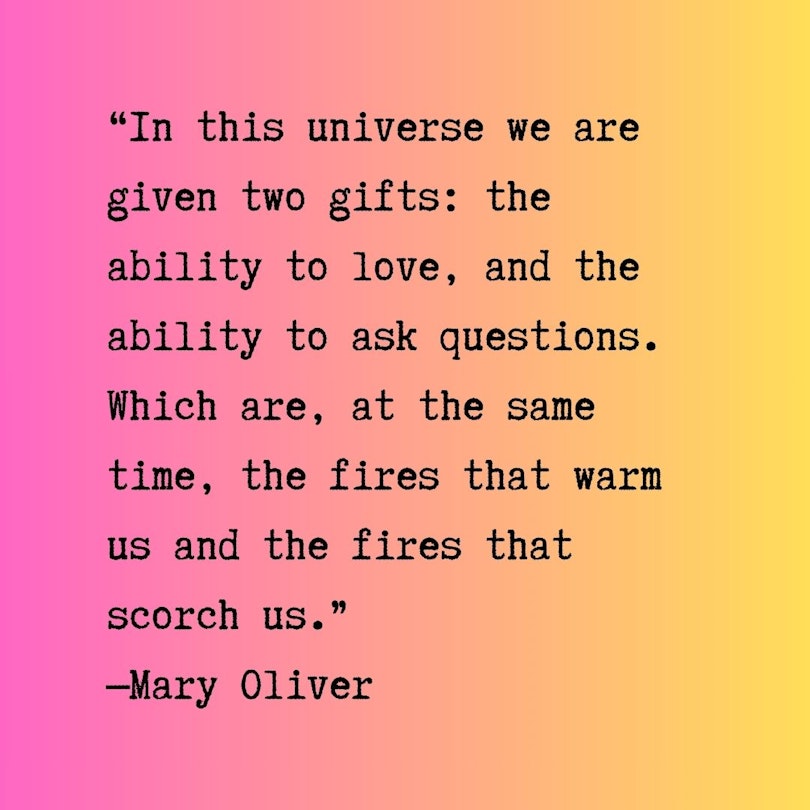
I was just shy of fourteen when one of my closest friends told me that he had a crush on me. Oddly, I don’t remember where we were, or what he said, or anything else at all for that matter, just that I was so glad that no one else had heard him. I was a bit terrified. For the rest of the day, despite the fact that I carefully avoided even eye contact with him, I felt a strange new warmth in my cheeks and an uncomfortable flutter in my stomach.
In those days, our bus rides home from school were long ones. Our homes were nestled in various different neighbourhoods in the heart of bustling Bangalore. But our school was still hidden deep in its undiscovered outskirts. One hundred acres of wild land, once barren brown, had been gifted to the philosopher, J. Krishnamurti, to begin a different kind of school: “an oasis, where one can learn a way of living that is whole, sane, and intelligent”.
By the time we inhabited it, it had grown into a sort of enchanted forest. As children, we had found wonderlands under fig trees, spent afternoons scouring tamarind trees for their sweet-sour fruits, delighted in spotting all kinds of birds, snakes, iridescent insects, and even poured plaster of paris into pugmarks every time a panther or two visited. Yet as we grew up, we retreated a little bit from the natural world into the labyrinths of our own hearts.
At home that evening, I found the first quiet moment with both my parents present to blurt out what had happened with my friend at school. “What did you say?” they were curious to know. “Nothing,” I said, “I ignored him for the rest of the day, of course,” I added somewhat self-righteously. For someone who prided herself in being rather independent-minded, I was surprisingly preoccupied with how my peers would react.
My parents, unperturbed by the whole storm in my teacup, were simply appalled by my reaction. Once again, I do not remember exactly what they said, but only that their equanimity helped me to find my own grace. While my friend’s courageous utterance may have tossed us into uncharted waters, it did not mean that I could forget everything I knew to be true in this new world. A crush did not make impracticable empathy or kindness.
A few months later when I felt the flutterings of something unfamiliar in my own being, I knew from that evening of quiet surprises that my parents’ hearts and home had the space to hold all the complexities that I would be confronted with. In that space, it was possible to observe myself and the world around me with a sense of perspective, to reflect on what I was feeling and why that might be, to share whatever was in my heart, without fear.
Over the next couple of years, we discovered that the school had an enlightened approach toward adolescence. Our teachers continued to treat us with affection and respect as they watched us bloom and grow, sometimes looking the other way at an awkward moment, sometimes laughing off a minor aberration with lightness, sometimes holding a boundary with tenderness, if the fallout might have consequences, always encouraging a spirit of inquiry.
Indeed, our teachers journeyed alongside us in much the same way that my parents did. Looking back now, it seems to me that they were all careful to keep at bay moral conventions, societal expectations, perhaps even their own conditioning. As far as possible, they wanted us to feel free to examine the contents of our own hearts, in their company, without fear. Only now, as an adult myself, can I imagine what an act of courage and care that must have been.
Someone once told me that, in those years, if a teacher ever appeared to be coming down too harshly on students in matters of the heart, our Principal, who was known for his warmth and candour, would sometimes ask, half jokingly, “Why? Are you jealous?” Perhaps, he was keen to see the school as a space where both children and adults could learn together, as J. Krishnamurti had hoped, about the world and about their own hearts and minds.
In fact, our Principal often engaged us in conversations about things no one else may have deemed appropriate for children. Everything from why the school needed a new Science Centre to euthanasia and what it might mean to die with dignity. With a twinkling smile, he encouraged us to disagree with him. With gentle teasing, he encouraged us to be outspoken. Before we graduated from school, he said, “If you love school so much, then come back here to teach.”
After school, I followed a poem of Sylvia Plath’s that I had fallen in love with to Smith College, where I felt quite the same way that she did there: “The world is splitting open at my feet like a ripe, juicy watermelon.” And then, still hungry for more, I made my way to Columbia University’s School of the Arts for graduate school. There, as part of a part-pedagogy, part-practicum seminar, “Writer as Teacher,” I began teaching a 9th grade class at a high school in Harlem.
I discovered the joy of building bridges between the texts that I wished to teach and students with whom I wished to share them. Bridges that would be built, no doubt, from my own careful close reading of the texts, my study of their literary and historical contexts, my lived experiences and little epiphanies, but, most of all, curiosity about how my students would wander through those “realms of gold” that were still uncharted territories for them. I knew then that I wanted to teach.
And so, about a decade after my Principal had first made his invitation, I returned to school to teach. He was most delighted that I had come back to nourish the place that had nourished me so. It was also a source of great joy for him that my high school sweetheart and I had found an enduring love, decided to get married, and to spend our lives together. However, not too long afterwards, we lost him all too early to a bad bout of pneumonia.
But perhaps, when one has had enough meandering conversations with children, the decades that intervene and even death, cannot dim the fires one has sparked, cannot crush the seeds one has sown. It has been more than ten years now that I have been teaching at school. Most of this time has been spent with adolescents. Not a single moral conundrum goes by without me remembering the affection, respect, courage, and care with which I was raised.
At the moment, I have been entrusted with the care of thirty-four 9th graders. If there is one thing that I am committed to doing, above all else, it is approaching the contents of their fourteen-year-old hearts and minds with curiosity, treating them with affection and respect, no matter what they say or do. Of course, as I stand at the blackboard with strands of silver appearing in my hair, sometimes this takes all the courage and grace I can muster.
It goes without saying that sometimes being their teacher means holding a boundary for them. But, in my experience, it is always possible to do this with kindness. It is always possible to be both gentle and firm. And in a moment when something has been ruptured, when something needs to be repaired, it is this very gentleness that brings tears into the eyes of a fourteen-year-old boy as he promises, with his whole heart, that he will not push that same boundary again.
As my wise students shared insightfully in a conversation last week, they find that they are more intrinsically responsible in environments where fewer rules are externally imposed upon them. Ironically, but intuitively, holding space for children to bloom and grow unbound often means that they will push up less against the boundaries that really matter. When we treat them with respect and affection, they will learn to treat themselves and others in the same way as well. And I thought to myself, could this perhaps even become, at another level, an antidote to the virulence of the conflicts that seem to be turning our world against itself?
I would like to be careful to keep at bay moral conventions, societal expectations, complicated legalese, even my own conditioning. I would not like to scrutinize the contents of their sharings or censor their as yet unfettered expression. Above all else, I wish they will feel free to examine the contents of their own hearts, in my company, without fear. Isn’t this how children bloom and grow? How else will they learn to love? How else will they learn to ask questions?
Not that long ago, my father-in-law shared a facet of our story that we didn’t know. Once, when we were still in high school, he opened the top drawer of his son’s desk and found a letter from me in it. A quick glance at the first few lines told him what it was. Without reading any further, he closed the drawer, knowing its contents were not meant to be subject to his scrutiny. With respect and affection for his growing son, he would simply journey beside him through it all.
Perhaps, what I find so moving about this story is that it was not an obvious choice for a man as traditional and religious as my father-in-law to make. Nor was it a choice that he made lightly or lazily, as he still remembers it almost twenty five years later. I suppose it gives me hope that, whatever our own conditioning might be, we can always find the warmth and wisdom to hold space for our children to bloom and grow.
If we can journey beside our children, as this most vital life force awakens within them, maybe they can learn to preserve their joy of being alive in their bodies, while also observing the tumultuous workings of their own minds and hearts with curiosity, rather than fearfully covering up their feelings out of shame. And I wonder if we can trust them enough to provide them with the freedom to do so because, as J. Krishnamurti said, “goodness only flowers in freedom”.